Violence Overview
Violence can be defined as causing injury to oneself or another. Violence can occur in any setting, between members of the same household or total strangers, and it can be deliberate or accidental. Power and control appear to be the basis for much of the violence that occurs. Firearms play a large role in violence in the U.S. because of their availability and ease of access. Consider the following figures:
Firearms and Violence in the United StatesIn 1996 there were 32,436 firearm-related deaths. These included:
More than 70% of homicides are committed with a firearm.2 Firearm assaults on family members and other intimate acquaintances are 12 times more likely to result in death than are assaults using other weapons.3 People living in households in which guns are kept have a risk of suicide that is 5 times greater than people living in households without guns.4 |
Youth and Violence
The magnitude of this problem can be simply stated: Each day, 17 youths between the ages of 15-24 are victims of homicide.5
-
Homicide is the leading cause of death for African American males ages 15-24.6
-
Homicide is the second leading cause of death for African American males ages 25-44, with HIV being the leading cause of death among African American males ages 25-44.6
- Homicide rates for young males began to decline in 1994 and dropped 34% between 1993 and 1997 (from 34.0 to 22.6/100,000). In 1997, the rate of homicide among males 15-19 years of age was 22.6/100,000 — a decline of 12.4% in one year.5 Despite this encouraging trend, rates are still unacceptably high.
Statistics on Youth and ViolenceIn 1997, 6,146 young people 15-24 years old were victims of homicide. This amounts to an average of 17 youth homicide victims per day in the US.2 In each year since 1988, more than 80% of homicide victims 15 to 19 years of age were killed with a firearm. In 1997, 85% of homicide victims 15 to 19 years of age were killed with a firearm.2 Arrest rates for weapons offenses among youths 10 to 17 years of age doubled between 1987 and 1993, then dropped 24% by 1997.7 In 1997, 5.9% of high school students in a national survey reported carrying a firearm at least once in the previous 30 days. In 1995, this was true of 7.6% of students — a decline of 22.4% over the two-year period.8, 9 |
Race, Gender and Violence
It is impossible to ignore the patterns of violence that emerge by race and gender. While these patterns are obvious, the causes that give rise to them are not. To get a complete picture of violence across the various populations of the United States, it is important to also look beyond gender and race at issues such as poverty, education and geographic location. This type of analysis goes beyond the purpose of this editorial. It is eye-opening, nonetheless, to look at superficial patterns, presented below:
Statistics on Violence by Race and GenderIn 1997, 4 out of 5 deaths by homicide and legal intervention were male, and 6 out of 7 were African Americans.1 The number of African Americans who died from injury by firearms in 1997 was 24.7 per 100,000, as opposed to 10.5 per 100,000 for whites. 1 The number of African American males who died from injury by firearms in 1997 was 46.1 per 100,000 (18.1 per 100,000 for white males).1 For males age 15-24, 119.9 per 100,000 African Americans and 24.8 per 100,000 whites died from injury by firearms.1 The number of African American suicides in 1997 was 3.6 per 100,000, as opposed to 7.2 per 100,000 whites.1 Life expectancy for white males was 7.1 years longer than for African American males in 1997 due to an advantage in the areas of heart disease, cancer, homicide, HIV infection and perinatal conditions. However, suicide and Alzheimers, killed more white males than African American males.1 |
The rise in violence peaked in the year 1993 when there were 15.4 deaths by firearm injury per 100,000 people. This fell to 12.1 per 100,000 in 1997. The reasons for this decline in recent years are unclear. It may be due to a number of factors such as better law enforcement, better prevention programs, the decline in crack use, and the incarceration or the death of many of the individuals in high-risk groups. In 1993 worldwide, over one million people died as a result of suicide or homicide.12 As a result, there is a widespread belief that much of the world is experiencing an epidemic of violence.
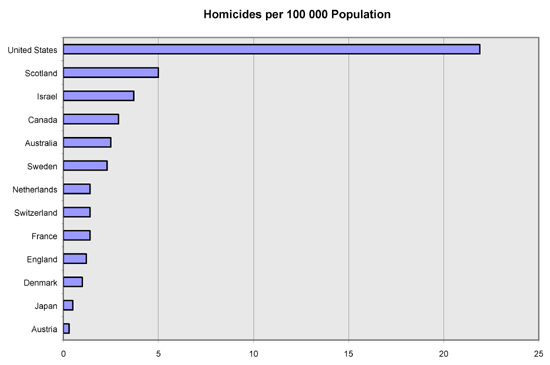
The following graph compares the homicide rates for males 15 through 24 in America with those in a sample of other developed countries.13
Economic Impact of Violence
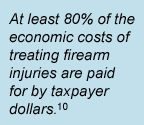
The economic impact of firearm-related homicide is substantial. In the United States, we spend more than $4.5 billion each year on medical costs for operations, hospital care, rehabilitation (such as physical and occupational therapy), and other forms of therapy and long term care. Most of that cost (85%) is for uninsured care, meaning that in the end taxpayers pay the bill. The economic impact in terms of lost wages and earning potential for those who are either killed, or temporarily or permanently disabled, is more than $20 billion per year. Since most victims of violence are in their teens or twenties, nearly 40 years worth of wages are lost. The social and emotional cost to families who lose loved ones, and to those temporarily or permanently disabled, are enormous. These costs cannot be expressed in terms of a dollar amount.
Violence Prevention and Intervention Strategies
Violence prevention strategies are designed to reduce the likelihood that those who have not yet engaged in violent behavior will do so in the future. They are also designed to teach people how to avoid becoming victims of violence. Violence intervention is needed if a person has already engaged in violent behavior, or is at high risk for being victimized or of committing violence against another. Three essential components of violence prevention and intervention programs include:
- Identification of high risk groups
- The proper program setting
- Appropriate program strategies
Adolescents are in a high-risk group – they are the most likely to be both victims and perpetrators of violent behavior. Violence is a learned behavior, and prevention programs should focus on teaching young children positive attitudes, interpersonal skills, and basic values. Families can play a key role in lowering the risk of violence among youth. Good programs support parents and provide intervention during family crises. Other positive role models for youth include extended family members or friends, teachers, counselors, and social workers. Adult mentoring can provide a positive, caring influence, and proper standards of conduct. A single adult mentor can serve as a powerful alternative to negative role models and help reinforce positive attitudes and behavior.
Violence intervention programs should be geared more toward specific high-risk groups, or individuals who display high-risk behavior such as injuring someone else or becoming victims themselves. Examples are gang members, youths who carry weapons, drug dealers or users, juvenile delinquents or youths with a history of fighting or victimization. Other high-risk youth are dropouts, the unemployed, the homeless, and immigrant or relocated youths. Abused or neglected children, children who have witnessed violence, and children with behavior problems are also at risk for violence.
Ideally, communities need to work together to provide many settings to reinforce positive messages. Effective programs designed to target at-risk youth and prevent violence can take place in churches, schools, homes, the playground, daycare centers, juvenile justice facilities, or at a medical center. The setting should be one that can reach the target group and should be appropriate for the strategy. In turn, program strategies should be appropriate for the setting. Adult mentors help many young people raised in high-risk conditions “make it” in life.
Conflict Resolution
Conflict resolution works very well in schools. The goal is to teach students to develop empathy towards others (i.e. being able to “walk in another person’s shoes” to understand their situation and how they feel), to learn self-control, and to develop problem-solving skills and anger management. Methods might include role-playing, and analyzing responses to-and the consequences of-violence. Students generally undergo many hours of training and often work in pairs. The training situations can involve bullying, stealing, spreading rumors, prejudice, competition, miscommunication, the inability to express feelings, lack of respect and concern for others.
Social Skills Training
Social skills training gives individuals the ability to interact positively with others, to learn self-control, communication skills, friendship, how to resist peer pressure, become assertive, and develop healthy relationships with adults. The goal is to teach appropriate standards of behavior, a sense of self-control over one’s behavior, and to improve self esteem.
Other Strategies
-
Firearm safety programs promoting measures such as trigger locks or locking up guns.
-
Public information programs can reach a broad audience, draw attention to an issue and provide general information. An example would be public service announcements, videos, and print materials.
-
Legal strategies might include laws regulating the sale, ownership, and use and carrying of guns. Other laws relating to school dress codes are also options. School uniforms reduce theft since students can no longer bring expensive designer clothing to school. Uniforms also prevent students from wearing gang colors to school.
-
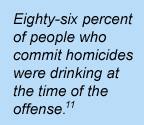
Laws relating to the sale and possession of alcohol. Scientists and nonscientists alike have long recognized a link between alcohol consumption and violent or aggressive behavior. Eighty-six percent of people who commit homicides were drinking at the time of the offense.11
-
Environmental changes can take place in two forms: 1) the social environment; and 2) the physical environment.
-
Social changes can take the form of pre-school and after school programs, team sports, Scouting, jobs, and volunteer activities that provide contact with positive adult role models.
- Improvements in the physical environment can be made to make it safer and more difficult for undesirable activity. Examples of how to make the physical environment safer include improving lighting on playgrounds and in parking lots and altering traffic flow patterns by the creation of one way or dead end streets. (This makes it more difficult for criminals to get in and out of neighborhoods). Buildings can also be made safer with closed circuit monitors, by limiting entry and exit sites, and locking side and back doors.
-
Social changes can take the form of pre-school and after school programs, team sports, Scouting, jobs, and volunteer activities that provide contact with positive adult role models.
Conclusion
While recent statistics show a steady declining trend, violence still remains a major public health problem. Prevention needs to occur at an early age, preferably before age 10. Behavior patterns become established and intervention becomes the goal beyond this age. Violence is a serious social and economic problem. Prevention programs must identify high risk groups such as adolescents and focus on teaching positive attitudes, conflict resolution, and social skills training. Success will require a comprehensive approach that addresses this issue on many different levels.
References
1. National Vital Statistics Reports, vol. 47, no. 19, Centers for Disease Control and Prevention, National Center for Health Statistics, June 30, 1999.
2. National Summary of Injury Mortality Data, 1987-1994. Atlanta, GA: Centers for Disease Control and Prevention, National Center for Injury Prevention and Control, November, 1996.
3. Saltzman LE, Mercy JA, O’Carroll PW, Rosenberg ML, Rhodes PH. Weapon involvement and injury outcomes in family and intimate assaults. JAMA 1992;267:3042-3047.
4. Kellermann AL, Rivara FP, Somes G, Reay DT, Francisco J, Banton G, Prodzinski J, Fligner C, Hackman BB. Suicide in the home in relation to gun ownership. New England Journal of Medicine 1992;327:467-472.
5. National Summary of Injury Mortality Data, 1981-1997. Atlanta, GA: Centers for Disease Control and Prevention, National Center for Injury Prevention and Control (Unpublished).
6. National Vital Statistics Reports, vol. 47, no. 19, Centers for Disease Control and Prevention, National Center for Health Statistics, June 30, 1999.
7. Snyder HN. Juvenile Arrest Rates for Weapons Law Violations, 1981-1997. Washington,
8. Kann, L., Warren, CW., Harris, WA. et al. Youth Risk Behavior Surveillance, 1995. Atlanta, GA: Centers for Disease Control and Prevention. CDC Surveillance Summaries, September 27, 1996. MMWR, 1996; 45, (No. SS-4).
9. Kann, L, Kinchen SA, Williams BI, et al. Youth Risk Behavior Surveillance, 1997. Atlanta, GA: Centers for Disease Control and Prevention. CDC Surveillance Summaries, August 14, 1998. MMWR, 1998 ; 47, (No. SS-3).
10. Max W, Rice, DP. Shooting in the dark: estimating the cost of firearm injuries. Health Affairs 1993;12(4):171-185.
11. National Institute on Alcohol Abuse and Alcoholism No. 38 October 1997.
12. World Health Organization (www.WHO.org.) – Emergency Humanitarian Action – Violence and Injury Prevention.
13. Fingerhut, Lois A., Kleinman, Joel C., International and Interstate Comparisons of Homicide Among Young Males. Journal of the American Medical Association (JAMA) June 27, 1990 Vol 263, No. 24.
For more information:
Go to the Domestic Violence health topic.