Insomnia
How Common is it to Have Difficulty Sleeping?
Sleep: Why Do We Need it?
Normal Sleep Cycle
The Effects of Aging on Sleep
If You Are Having Trouble Sleeping. . .
Drugs that Help You Sleep
The following chart shows the results of the 2005 Sleep America Poll that relate to symptoms of insomnia. More than half of those polled reported experiencing symptoms of insomnia (indicated by the Dragging Duos, Overworked, Overweight, and Overcaffeinated, and the Sleepless and Missin’ the Kissin’ groups).
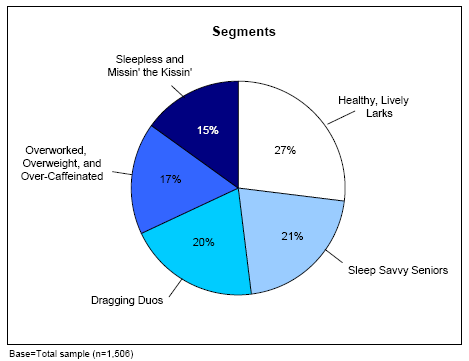
Source: 2005 Sleep America Poll, National Sleep Foundation
Insomnia can involve difficulty in falling asleep, waking up frequently at night, waking up too early in the morning, or waking up and not feeling refreshed. Insomnia is not a disease but a symptom. It can be caused by an underlying sleep disorder, or might be brought on by something as simple as a change in schedule, a stressful event at work, or an afternoon cup of coffee. Insomnia becomes more common as people grow older, and is also more common in women.
Sleep: Why Do We Need it?
Sleep plays an important role in our overall well-being. Many body functions suffer if we don’t have regular sleep:
- Growth of new tissue and healing
- Control of body temperature
- Control of how energy is used (the body’s metabolism)
- Immune system performance (defending the body against illness)
- Brain function and memory performance.
People who don’t sleep well are also more apt to have accidents, abuse substances such as alcohol, and even suffer greater illness and disease.
Normal Sleep Cycle
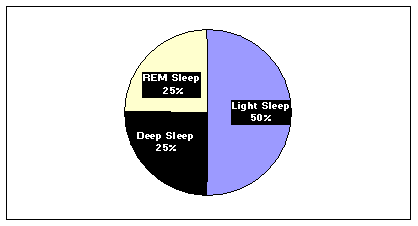
In falling asleep and sleeping, people go through predictable stages –
- Light sleep (approximately 50%)
- Deep sleep, called “slow wave” sleep, associated with feeling refreshed and restored (25%)
- REM (Rapid Eye Movement Sleep or Dream Sleep), during which dreams occur, rapid eye movements, and changes in breathing and muscle tone (25%)
The Effects of Aging on Sleep
With normal aging, people spend more time in light sleep, less time in deep sleep and have less REM sleep.
With age, sleep becomes less “efficient.” People take longer to fall asleep, wake up more frequently and spend more time awake. Older people also:
- Wake up more often throughout the night
- Have less total sleep time
- Spend more time in bed
If You Are Having Trouble Sleeping…
Are you dissatisfied with your sleep? Do you routinely become sleepy during the day? Does your bed partner notice any unusual behavior while you sleep? Answering “yes” to any of these questions may mean that you have a sleep disorder. Before considering non-prescription or prescription sleep medications, try the following:
Figure out the Cause and Try to Reduce its Effect
- Are Medications and Drugs Causing Your Insomnia?
- Are There Patterns Associated With Your Insomnia?
- Are You Depressed?
Are Medications and Drugs Causing Your Insomnia?
Certain medications can interfere with normal sleep patterns. Following is a list of drugs that can cause insomnia:
| Drug | Common Source or Use |
| Alcohol | Found in beer, wine, liquor |
| Anticonvulsants | Used to treat epilepsy |
| Bronchodilators | Used to treat asthma, emphysema |
| Caffeine | Found in coffee, tea, soft drinks, over-the-counter pain medications |
| Cocaine | Used as a stimulant (illegal) |
| Estrogen | Used in hormone replacement therapy |
| Levodopa | Used to treat Parkinson’s Disease |
| MAO inhibitors | Used to treat depression and mental health problems |
| Ritalin | Used to control hyperactivity and ADD |
| SSRIs (such as prozac) | Used to treat depression and mental health problems |
| Steroids | Used to treat emphysema, asthma and many other chronic diseases |
| Sympathomimetics | Found in cold remedies |
| Theophylline | Used to treat asthma |
| Thyroid hormone | Used to treat underactive thyroid (metabolic disorders) |
Are There Patterns Associated With Your Insomnia?
If you consult with your health care provider about your insomnia, he/she may ask you to keep a sleep diary. Your diary could look something like this:
Sleep Diary
| Date | Bedtime | Time to fall asleep | Sleep quality >(1 to 5) |
Total sleep time | Level of Refreshment >(1 to 5) |
Daytime Sleepiness >(1 to 5) |
Related events/ >Stressors |
| 3/26 | 11pm | 1 hour | 3 | 5 hours | 3 | 4 | 1 cup coffee 3pm |
| 3/27 | 12am | Over an hour | 3 | 6 hours | 3 | 3 | Fight with boss |
| 3/28 | 11pm | 25 min? | 4 | 7 hours | 4 | 3 | No caffeine |
| 3/29 | 12am | 45 min | 3 | 5 hours | 3 | 3 | 22 oz coke 3pm |
Are You Depressed?
Depression can take a toll on your ability to sleep. The self-administered Patient Health Questionnaire 9 is a test for diagnosing depression that you can take yourself. If you are concerned about depression, ask you health care provider about taking this test.
Practice Good “Sleep Hygiene”
Good sleep hygiene describes methods you can use to encourage drifting off into quality sleep. Some examples follow:
- Wind down prior to bedtime
- Do not smoke (nicotine is a stimulant) or consume caffeine
- Try warm milk or a light snack before bed (if this doesn’t interfere with another treatment you are using)
- Exercise daily, but not right before bedtime
- Take a warm bath, but not right before bedtime
- Keep a regular bedtime and rising time
- Get in the habit of going to bed when you are sleepy and sleeping where you sleep best
- Reserve your bed for sleeping only
- Don’t have any clocks visible to you
- Reduce the amount of time you allow yourself to sleep until you fall asleep easily (your health care provider can help with this form of “sleep restriction therapy”
- Schedule worry time during the day and put worries out of your head when it is time to sleep; you can write them down on 3×5 cards, and then let go of them
- Get up if you have not fallen asleep in 15 minutes and practice a relaxing activity (e.g. handwork, reading a boring book) until you feel sleepy
Over-the-Counter Sleep Aids
Non-prescription medications for insomnia are usually antihistamines and may have significant side effects including:
- “Carry over sedation” (fatigue and tiredness the day after taking them).
- Falls
- Difficulty with urination (especially in older men).
Additional concerns with both non-prescription and prescription sleep medications are that they can be habit-forming and addictive. More recently, natural remedies have been promoted to help people sleep. Examples include valerian and melatonin:
- Valerian is believed to aid sleep by sedating the central nervous system.
- Melatonin is a hormone produced in the body by the pineal gland in the brain. Melatonin supplements are thought to be particularly effective in patients with jet lag and disorders of the sleep-wake cycle. A relatively new prescription brand of melatonin is available.
There are downsides to over-the-counter melatonin and valerian, too. Because melatonin is an animal product, it can be contaminated with viruses or other problems. In addition, the FDA does not regulate valerian and over-the-counter melatonin, so the purity and potency may vary widely. Many researchers are skeptical of the effectiveness of either valerian or over-the-counter melatonin in relieving insomnia.
While there are varying opinions on the over-the-counter sleeping aids mentioned above, all experts agree: You should never use alcohol, illicit drugs or medications prescribed for a friend for your sleep problems.
Prescription Sleep Medications
There are three commonly recognized classes of sleep medications. The oldest of these classes is the benzodiazepines (e.g. triazolam, flurazepam). These medications are effective for short-term treatment of insomnia, but should always be used under a physician’s supervision. Side effects typically include sedation the next day, impairment of performance, and particularly in elders, dizziness and falls. Newer, non-benzodiazepine medications, such as zolpidem, zaleplon, and eszopiclone, work similar to the benzodiazepines but may avoid some of the benzodiazepine side effects. Because these medications have different duration of action, some are more suited for treating sleep disturbance in the middle of the night. The newest prescription class of medication is the melatonin agents such as ramelteon. Ramelteon is not a controlled substance. Other medications, such as sedatives and antidepressants (e.g. trazodone) are also used as sleep aids.
The benefits, side effects and contraindications (non-compatible drugs) vary for each class of sleep medication. Your healthcare provider can help you select the best sleep medication for your needs.
For Further Reading:
Kryger, Meir H., Thomas Roth, and William C. Dement (eds). Principles and practice of sleep medicine, 4th ed. Philadelphia, PA: Elsevier/Saunders, 2005.
For more information:
Go to the Sleep Disorders health topic.